


Maslow’s Hierarchy for the Nonprofit Board Member
Board members don’t become an organization’s champions simply by joining a board. They become champions when we help them grow into the role. That distinction matters.
Too often, nonprofits recruit talented, well-connected people, welcome them with a binder and a board packet, and then quietly expect them to know how to lead, advocate, fundraise, govern, and represent the mission. And when they don’t? We label them “disengaged.”
But what if disengagement is often less about willingness—and more about development (or the lack of it)?
That’s where Maslow gives us a useful lens.
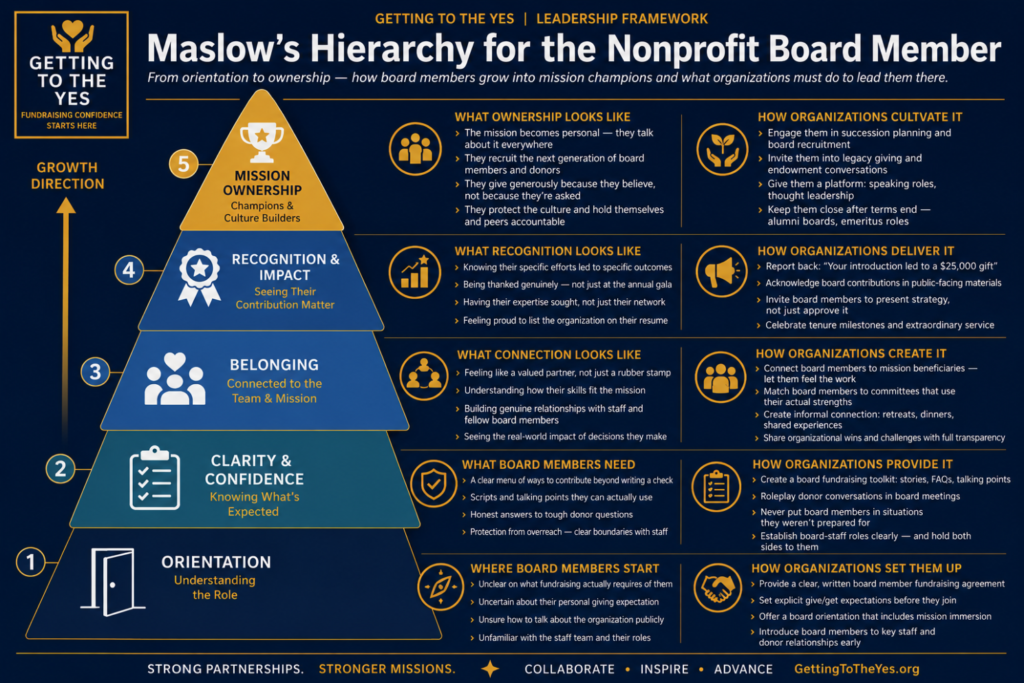
Just as people move through levels of need before reaching self-actualization, board members also move through stages of confidence, connection, contribution, and ownership.
They need to know where they fit before they can fully lead.
Level 1: Orientation
Every board member begins their nonprofit journey with a fundamental question: What exactly am I supposed to do here?
That sounds simple, but it is one of the most overlooked questions in board development.
New board members are often unclear about:
what fundraising actually requires of them,whether they are expected to give personally,how they should talk about the organization,what their role is compared with the staff,and where governance ends, and operations begin.
If we want board members to become confident ambassadors, fundraisers, and leaders, we cannot leave those expectations implied.
Orientation should include far more than bylaws and financial statements.
It should give board members a clear picture of the mission, their responsibilities, the organization’s fundraising philosophy, and the ways they can contribute.
Clarity is the first step toward engagement.
Level 2: Clarity & Confidence
Once board members understand the role, they need to believe they can succeed in it. This is where many organizations unintentionally lose people.
We tell board members to “help with fundraising,” but we don’t equip them with the language, tools, stories, or practice they need. Then we wonder why they hesitate.
Confidence grows when board members have:
clear talking points,compelling stories,answers to difficult donor questions,simple ways to introduce people to the mission,and permission to contribute in ways that match their strengths.
Not every board member needs to make a solicitation. But every board member should understand how they can advance philanthropy. The goal is not to force everyone into the same fundraising role.
The goal is to give every board member a role they can own. And that’s what we call a “Culture of Philanthropy”.
Level 3: Belonging
Board members who feel connected behave differently from board members who simply attend meetings.
They speak about the organization with more conviction. They advocate more naturally. They invite others in. They stay engaged when the work becomes difficult.
Belonging happens when board members understand how their individual skills connect to the mission—and when they build real relationships with the people and communities the organization serves.
That means creating opportunities beyond the boardroom.
Let them see programs. Let them meet the staff. Let them hear directly from people impacted by the mission. Let them build relationships with one another.
A board that feels like a team will almost always outperform a board that functions like a collection of résumés.
Level 4: Recognition & Impact
Board members also need to know that what they do matters. Not in a superficial awards-and-applause way. They need evidence.
If a board member opened a door that led to a $25,000 gift, tell them. If their introduction helped secure a partnership, tell them. If their expertise changed a strategy, tell them. If their advocacy brought someone new into the mission, tell them.
People repeat behaviors they understand are making a difference. Too often, we thank board members generally: “Thank you for all you do.” But specific recognition is far more powerful.
Your introduction led to this relationship.
Your idea helped us solve this problem.
Your leadership moved this work forward.
That is how contribution becomes identity.
Level 5: Mission Ownership
At the highest level, something changes. The organization is no longer simply “the nonprofit I serve on the board of.” The mission becomes personal.
These board members talk about the organization everywhere. They recruit future leaders. They open doors without being prompted. They protect the culture. They give generously because they believe. They challenge the organization because they care. They begin thinking beyond their own board term and asking: What does this organization need to thrive after I’m gone?
That is mission ownership. And it is the level most nonprofits want from their board members. But ownership cannot be demanded.
It has to be cultivated.
The Leadership Lesson
The mistake is expecting Level 5 behavior from someone who is still standing at Level 1. We want board members to advocate passionately before they understand the story. We want them to open doors before they feel connected. We want them to think like ambassadors before they have experienced their own impact.
Then we call it a board engagement problem. Sometimes it is. But sometimes it is a board development problem.
Strong boards are built intentionally. They are oriented, equipped, connected, and shown their impact. And eventually, many of them become something far more powerful than volunteers sitting around a board table.
They become champions of the mission.
That is the journey from orientation to ownership.
And when organizations learn how to lead board members through that journey, philanthropy gets stronger right along with them.
Strong partnerships. Stronger missions.
You Deserve the Yes. Unlock your confidence, find your voice, and create real, lasting outcomes.

This article first appeared in The Yes Advantage Insider, the Getting to the Yes newsletter on LinkedIn.