


The Five Shifts That Transform a Good Board Into a Great One
Let me ask you something.
When was the last time a board member walked into a room, introduced themselves as an ambassador for your mission, and made a donor feel something?
If you had to think about it, this issue is for you.
I’ve been blessed to work alongside hundreds of board members. Most of them are smart, generous, and genuinely committed. And most of them are operating in a role that is smaller than what the mission actually needs.
That’s not a criticism. It’s a system problem.
We recruit board members for their expertise, seat them at the governance table, and assign them to a committee. Then we wonder why donor engagement feels flat and community visibility stalls.
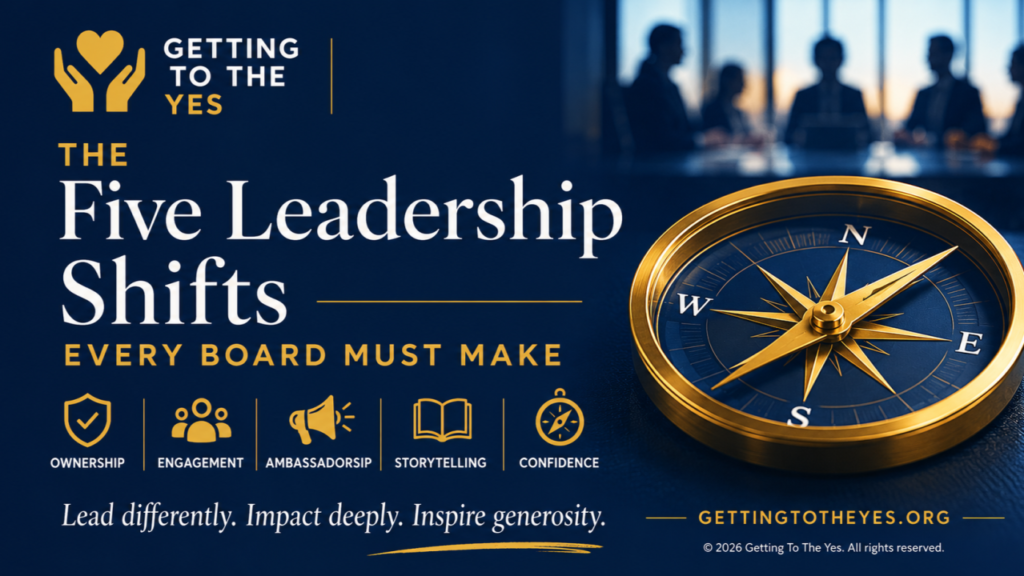
This week’s article is from Chapter 5 of Getting to the Yes: A Board Member’s Guide to Philanthropic Leadership and is built around a simple premise: the difference between a good board and a transformational one isn’t talent. It’s the willingness to make five intentional shifts. Here’s what they are, and why they matter.
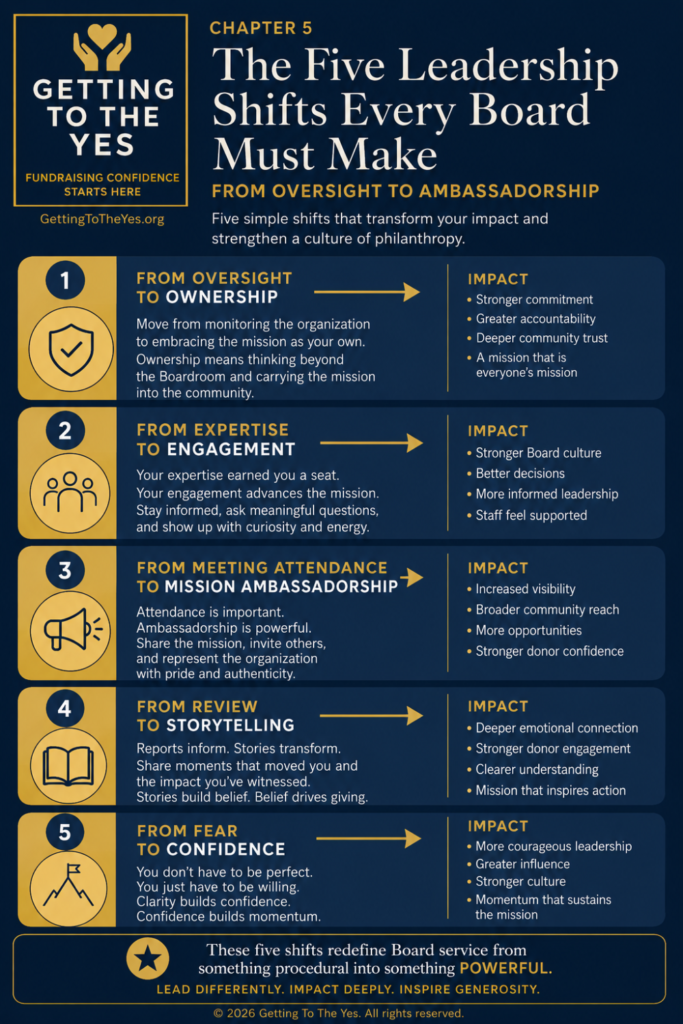
Shift 1: From Oversight to Ownership
Governance is necessary. Ownership is powerful. When a board member moves from monitoring the organization to genuinely embracing the mission as their own, everything changes. They stop asking “how are we performing?” and start asking “how can I help?”
Ownership carries the mission beyond the boardroom and into the community, and that kind of reach is something no staff team can manufacture on its own.
The impact: stronger commitment, greater accountability, deeper community trust, and a mission that truly belongs to everyone.
Shift 2: From Expertise to Engagement
If you’re a Board member, your expertise earned you a seat at the table. Your engagement advances the mission.
Too many board members sit quietly through meetings, deferring to staff or to louder voices in the room. But engaged board members ask meaningful questions, stay curious, show up with energy, and make the people around them better. A board that is actively engaged makes better decisions, builds a stronger culture, and gives staff the feeling that leadership has their back.
The impact: a board culture that attracts other great people and produces informed, confident leadership.
Shift 3: From Meeting Attendance to Mission Ambassadorship
Attendance is a baseline. Ambassadorship is a multiplier.
Every board member has a network. The question is whether they’re using it. When board members share the mission in their everyday conversations, invite others to learn more, and represent the organization with pride and authenticity, they become one of the most powerful fundraising leaders you have.
The impact: increased visibility, broader community reach, more opportunities, and donors who trust the organization because someone they trust vouches for it.
Shift 4: From Review to Storytelling
Reports inform. Stories transform. Data has its place, but it rarely moves people to give. Stories do.
When board members share the moments that moved them, the impact they’ve witnessed firsthand, and the reasons they personally show up, something shifts in the listener. Belief grows. And belief drives giving.
The impact: deeper emotional connection, stronger donor engagement, and a mission that inspires action instead of just awareness.
Shift 5: From Fear to Confidence
This is the one that unlocks everything else. So many board members stay silent because they’re afraid of saying the wrong thing, offending a friend, or seeming pushy. But here’s what I tell every board I work with: you don’t have to be perfect. You just have to be willing. And I don’t expect you to ask anyone for money.
Clarity builds confidence, and confidence builds momentum. When board members stop waiting to feel ready and start practicing donor cultivation, the culture of the entire organization shifts.
The impact: more courageous leadership, greater influence, a stronger culture, and momentum that actually sustains the mission over time.
These five shifts redefine board service from a procedural to a powerful practice.
These shifts don’t require a board retreat, a consultant, or a complete governance overhaul. They require intention, a good conversation, and the courage to ask your board to show up differently. Lead differently. Impact deeply. Inspire generosity.
I’d love to hear from you. Which of these five shifts feels most needed on your board right now? Hit reply and tell me. I read every response, and your answer might just shape a future issue of The Yes Advantage Insider.
Until next week, keep getting to the yes,
Kim
This article first appeared in The Yes Advantage Insider, the Getting to the Yes newsletter on LinkedIn.