


Why the Right Story Is Worth More Than the Perfect Ask

Most fundraisers spend hours crafting the perfect words for a donor solicitation. They rehearse the number. They practice the pause. They script every transition.
And then a board member stands up at a cultivation event, tells a two-minute story about why this organization changed their life, and a donor writes a check on the spot.
That is not a coincidence. That is the power of story.
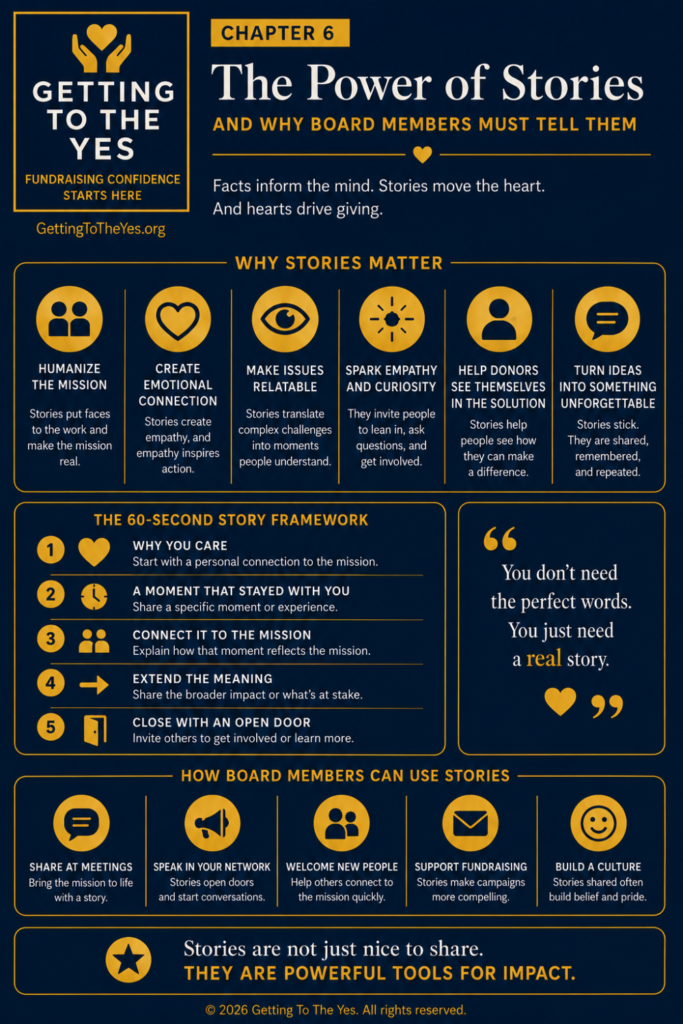
Chapter 6 of Getting to the Yes: A Board Member’s Guide to Philanthropic Leadershipis called “The Power of Stories and Why Board Members Must Tell Them.” It might be the chapter that surprises people the most, because it shifts the focus away from technique and toward something every board member already has: a personal experience that connects them to the mission.
Facts inform. Stories move.
Donors do not give because of pie charts. They give because something moved them. Data builds the case. The story builds the bridge. And it is the bridge that gets you to the yes.
The six reasons stories matter are not theoretical. They show up in every successful campaign, every major gift conversation, and every board meeting that ends with a donor saying, “Tell me more.”
Humanize the mission. Create emotional connection. Make issues relatable. Spark empathy and curiosity. Help donors see themselves in the solution. Turn ideas into something unforgettable.
The 60-Second Story Framework
One of the most practical tools for crafting a compelling story is the 60-Second Story Framework. Five steps. No speechwriting degree required.
Start with why you care. Share a moment that stayed with you. Connect it to the mission. Extend the meaning to what is at stake. Then close with an open door.
That is it. And when a board member owns it, practices it, and delivers it with authenticity, it is more effective than any polished pitch deck you could put in front of a donor.
You do not need the perfect words. You just need a real story.
This gives board members permission to stop performing and start connecting. And that permission is often exactly what they need to step into their role with confidence.
If your board is not yet telling stories, this is where you start. Help them find the moment. Give them the framework. Then get out of the way and let the story do the work.
The yes follows.
If this is the kind of thinking your board needs, follow the Yes Advantage Insider, published weekly here on LinkedIn. It is written for nonprofit leaders who are ready to lead with intention and build something that lasts.
This article first appeared in The Yes Advantage Insider, the Getting to the Yes newsletter on LinkedIn.